
 Login
Login Create Account
 Forgot your password?
 Builders
 D&D 5e Character Builder
 D&D 5e Character Builder for newbies
 D&D 5e Spells
 D&D 5e Monsters
 D&D 5e Items
 Generators
 D&D 5e City Generator
 D&D 5e NPC Generator
 D&D 5e Name Generator
 D&D 5e Rumor Generator
 D&D 5e Wanted Poster
 Dungeon Master Resources
 Ultimate list of DM Screens
 Ultimate DM Generators, Maps, and World building resources for D&D 5e
 Ultimate list of Virtual Table Tops (VTTs) for D&D
 Help
Help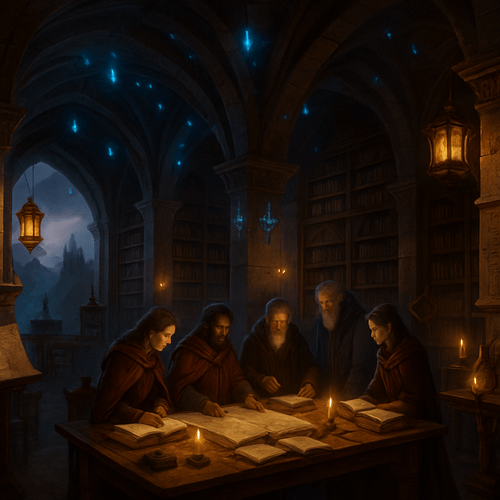
Would a Contemporary School Exist in a Medieval World?
When the party first burst through the iron gates of the Old Academy, the smell of burnt parchment and hot wax mingled with the damp chill that seeped from stone walls. The hall was lined with rows of desks, each carved from oak so fine it seemed almost… modern. A chalkboard hung at the front—no, a slate board, but with the neatness of a scholar who had seen the world beyond the kingdom.
The bard laughed, “I swear I saw a lecture on algebra in that very room!” And yet, when he tried to pull out his lute for a lullaby, the wooden frame creaked and whispered, “That’s not how we do music here. Turn it down.”
That was my first night at the table. The players had wanted a medieval setting with a twist: an academy that taught calculus, astronomy, even a rudimentary form of steam engineering. I stared at their character sheets—sages with scrolls, fighters who could recite the Pythagorean theorem—and thought, “Could we really pull this off?” It was a question many of us DM‑folk have wrestled with: can you transplant a slice of modernity into an old‑world backdrop without making it feel like a hack?
The Root Problem: Context or Convenience?
- Context matters more than convenience. If the world’s lore explains why people are literate, why knowledge is prized, and how technology trickles upward, then the academy feels earned.
- A convenience answer—“we’re just giving them a school” – often leaves players scratching their heads. They’ll notice missing links: who built it? Who pays for the books? Why do commoners attend?
In the world I was building, education is a sacrament. The clergy has long argued that understanding scripture requires an educated mind. But they also claim that only the elite can afford to learn. That’s where my players’ idea of universal access clashes with the established narrative.
A Quick Reality Check
- Literacy rates: In most medieval societies, a fraction of the population reads. An academy that serves all classes must have a reason—political stability? Economic boom? Perhaps the tower of high sorcery… only the elect get to go.
- Infrastructure: Paper is scarce; books are hand‑copied. If you want many students, you need either cheap parchment or mass‑produced manuscripts.
- Funding: Who pays the teachers? Taxes? Donations from merchants who see a literate workforce as profitable?
If you ignore these, your setting feels like an overgrown sandbox where everything works because the DM said so. That’s fine for a one‑shot, but for a campaign that needs depth, it becomes a crutch.
Building a Plausible Backstory
Let me give you a skeleton I used in my own world: The Kingdom of Valeron had just discovered a new trade route to the northern steppes. Merchants brought exotic goods—silks, spices, and… paper! Paper was cheap enough that monasteries began printing religious texts instead of hand‑copying them.
The king, seeing an opportunity, decreed Free Learning for All. The clergy funded the first public school; the merchants supplied ink; the craftsmen built desks. Education became a civic duty: every boy and girl learned reading, arithmetic, and basic geometry—skills useful in trade, agriculture, and warfare.
How to Make It Feel Real
- Anchor it in politics: A king or council that sees value in an educated populace for tax collection or military efficiency.
- Tie it to religion: If the church is a patron of learning, the curriculum may blend theology with science. Think “Theologians who also know how to calculate the trajectory of a cannon.”
- Show incremental progress: The first academies are modest—one room, one teacher. Over generations they expand; new subjects appear as technology spreads.
Mechanics That Reinforce Reality
Skill Checks and Knowledge
- Invest in History or Religion: Players who attend the academy gain bonuses to history checks about local lore. This explains why an orphaned bard can recite a forgotten hymn with ease.
- Class‑specific learning: A fighter might take a Combat Training course, gaining proficiency in weapon handling. A wizard could study Arcane Geometry, improving their spellcasting precision.
Feats and Backgrounds
- Create a Scholar background that grants the Researcher feat automatically.
- Offer a Public School Graduate feat: +1 to Charisma checks when persuading townsfolk, reflecting how education builds confidence.
Resource Management
- Bookkeeping: Let players manage school funds. They can decide whether to buy new scrolls or repair desks—introducing budgeting challenges.
- Time Investment: A full semester might be a month in game time; the DM can schedule learning sessions as mini‑quests (e.g., “Find the lost ledger of the scribe.”).
In‑Game Example: The Academy’s Annual Feast
Picture this: the academy hosts its first Feast of Learning—a banquet celebrating knowledge. The students perform recitations, display their inventions, and present a “Paper Prototype” of a simple lever.
During the feast, a rival noble whispers that the academy is “too liberal,” threatening to cut funding. The players must decide: defend the school, negotiate with the council, or sabotage the rival’s plans.
DM Note: Use this event to explore consequences. If funding is cut, the academy’s curriculum shrinks; if defended successfully, new subjects become available.
What Players Can Do
- Negotiate: Use Persuasion checks against a Noble NPC.
- Investigate: Search for evidence of corruption in the noble’s ledger.
- Combat: Defend the school from an angry mob sent by the rival.
The outcome should ripple through future sessions—perhaps the academy becomes a hub for clandestine research, or it falls into disrepair and must be rebuilt.
Common Mistakes I’ve Seen at the Table
- Assuming all classes automatically get the same education. In reality, artisans might learn different skills than scholars.
- Ignoring economic implications: A free school requires resources; players should feel its cost.
- Over‑simplifying technology: If you let a medieval world have steam engines, explain the metallurgy and fuel sources.
Quick Tips for Your Campaign
- Start small: Begin with a single class or subject. Let it evolve organically.
- Use NPCs to anchor reality: Have a schoolmaster who knows every student’s progress; he can be a valuable ally or informant.
- Balance freedom and structure: Players should feel they can shape the academy, but there must be limits—budget, politics, tradition.
A Mini Encounter You Can Drop In
The Hall of Scrolls – The players are called to retrieve a lost scroll from the academy’s archives. Inside, they find:
- A locked chest containing a rare manuscript.
- An automated guardian (a golem built by an eccentric scholar).
- A note: “If you wish to learn, prove your worth.”
Players must solve riddles based on the academy’s curriculum to unlock the chest. Success grants them knowledge bonuses for a week.
From Behind the Screen: The DM Perspective
When I first tried to justify a modern‑style school in a medieval world, my players laughed and asked “Why would people read?” That was the moment I realized I needed more than a good story; I needed a plausible economy of knowledge. I started weaving in the political push for literacy as a way to tax better and fight better.
Now, when they ask why the academy still runs after a war, I can point to a war‑torn charter that says: “Education is a shield against barbarism.” The players feel their choices matter; the world feels lived in.
A Gritty Plot Hook
A new king has ascended and is suspicious of the academy’s influence. He orders an inspection. If the players fail to convince him, the school will be shut down—literacy lost for generations. The stakes are high: a medieval society with contemporary learning suddenly faces a regression that could alter its destiny.
Final Thought
Building a contemporary school in a medieval world isn’t a cheat; it’s an opportunity to explore how knowledge changes power dynamics, economics, and culture. Treat it as a living institution—grow it, protect it, let it fail. That’s the difference between worldbuilding and world‑making.
“Education is the best weapon in a world that keeps its swords hidden.” – An old scholar who once taught a rogue bard.
Till next time, watch your torches and check for… OH CRAP DRAGON!!?….
Enjoying the Vault? Support the adventure.
Join our community of DMs on Patreon and help keep the tools free, updated, and growing. Every tier makes a difference.
Cancel anytime. No pressure — just gratitude.