
 Login
Login Create Account
 Forgot your password?
 Builders
 D&D 5e Character Builder
 D&D 5e Character Builder for newbies
 D&D 5e Spells
 D&D 5e Monsters
 D&D 5e Items
 Generators
 D&D 5e City Generator
 D&D 5e NPC Generator
 D&D 5e Name Generator
 D&D 5e Rumor Generator
 D&D 5e Wanted Poster
 Dungeon Master Resources
 Ultimate list of DM Screens
 Ultimate DM Generators, Maps, and World building resources for D&D 5e
 Ultimate list of Virtual Table Tops (VTTs) for D&D
 Help
Help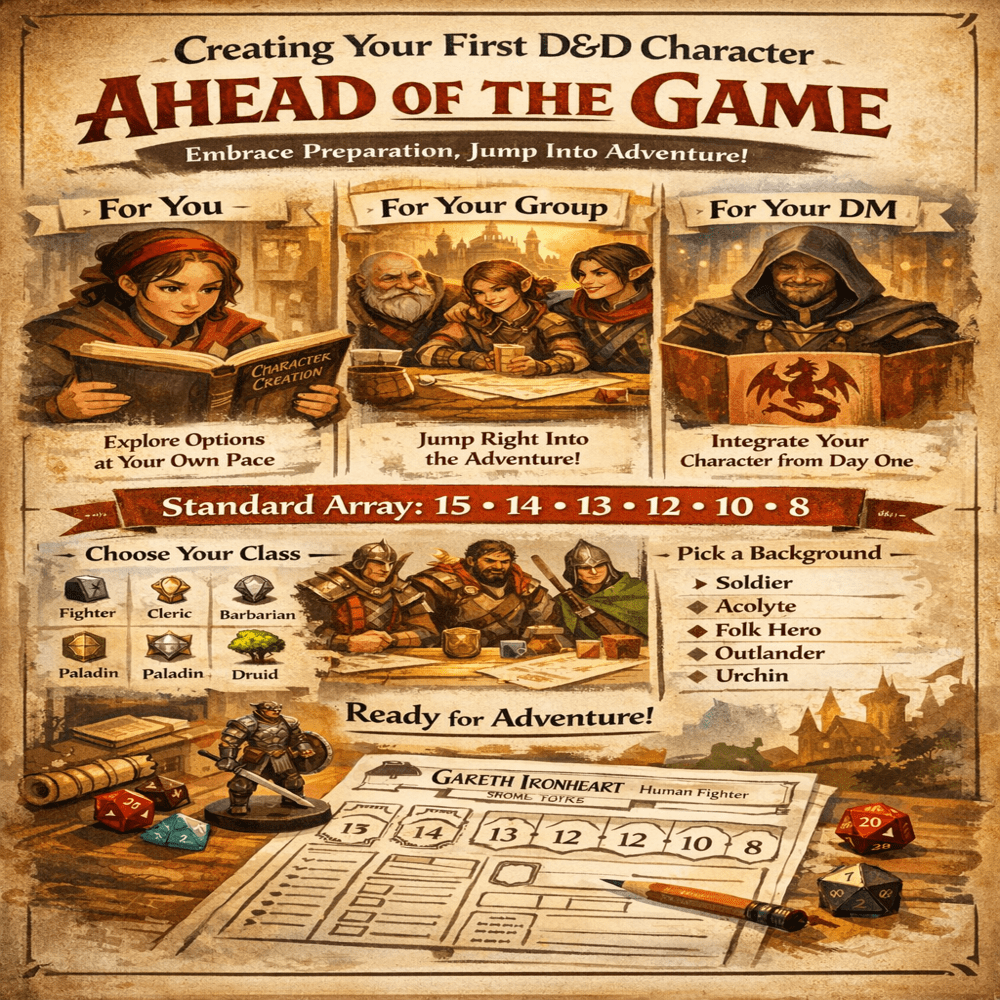
You’ve been invited into the world of Dungeons & Dragons. Perhaps a friend has gathered a group, or maybe you’re joining an organized play event at your local game store. The Dungeon Master reaches out with one request: “Could you create a character sheet before our first session?”
Your mind races. Is this the right move? Will you make mistakes? What if you choose wrong and ruin your experience before it even begins?
Take a deep breath, adventurer. You’re about to discover that creating a character ahead of time isn’t just acceptable—it’s often the smartest choice you can make as a new player. Let me walk you through everything you need to know.
Why Creating Ahead Makes Sense
Before diving into mechanics, understand why pre-creation benefits everyone at the table:
For You: Character creation in D&D 5th Edition involves multiple steps—choosing race, class, background, abilities, skills, equipment, and calculating derived statistics like hit points and armor class. Doing this during a first session means making decisions under pressure while everyone waits. Pre-creation lets you explore options at your own pace, consult guides, and ask questions without feeling rushed.
For Your Group: When you arrive prepared, the group can jump straight into adventure rather than spending an hour watching one person navigate character creation rules. This shows respect for everyone’s time and demonstrates genuine enthusiasm for the game.
For Your Dungeon Master: A completed character sheet allows the DM to integrate your character into their campaign world before session one. They might create plot hooks tied to your background, arrange encounters that showcase your class features, or weave your character’s story into the larger narrative from day one.
The Standard Array: Your Starting Point for Ability Scores
The Reddit post we’re responding to mentions using the “standard array.” This is an excellent choice for new players, and here’s why:
The standard array consists of six numbers: 15, 14, 13, 12, 10, 8
These represent your raw ability scores before racial modifiers. You assign them to the six abilities however you choose:
- Strength (STR) — Physical power and athletic ability
- Dexterity (DEX) — Agility, reflexes, and finesse
- Constitution (CON) — Health, stamina, and resilience
- Intelligence (INT) — Reasoning, memory, and academic knowledge
- Wisdom (WIS) — Perception, intuition, and insight
- Charisma (CHA) — Personality, force of will, and social grace
Why the Standard Array Works Well
Many groups use ability score generation methods like rolling 4d6 and dropping the lowest die. While this can produce exciting high scores, it also risks creating unbalanced characters or requiring time-consuming re-rolls. The standard array guarantees every character starts with comparable power levels while still allowing meaningful customization through placement.
Placement Strategy for New Players
Here’s a simple framework:
Identify your primary ability — This depends on your chosen class. Fighters and Barbarians prioritize Strength, Rogues and Rangers favor Dexterity, Wizards need Intelligence, Clerics require Wisdom, and Bards depend on Charisma. Place your 15 here.
Choose your secondary ability — Constitution matters for every character because it determines hit points and helps you maintain concentration on spells. Most melee characters also want decent Dexterity for armor class and initiative. Put your 14 here.
Fill in supporting abilities — Your remaining scores (13, 12, 10, 8) go to abilities less critical to your character’s function. A wizard might dump Strength into the 8 since they rarely engage in physical combat, while a barbarian might place Charisma last.
Choosing Your First Class: Five Solid Options for Beginners
D&D offers twelve base classes, each with unique playstyles and mechanics. For someone creating their first character, I recommend starting with one of these five beginner-friendly options:
The Fighter
Fighters excel in combat through versatility and durability. They gain multiple attacks early, can take down weapons and armor without penalty, and receive fighting styles that enhance their capabilities. A Defense fighting style fighter adds 1 to armor class whenever they wear armor, while Great Weapon Master lets them trade attack accuracy for devastating damage.
Why it works for beginners: Simple mechanics, high survivability, always relevant in combat.
The Cleric
Clerics combine spellcasting with martial capability. They heal allies, buff the party, and deal divine damage while wearing heavy armor and wielding maces or hammers. Domain choices like Life maximize healing, while War clerics function as frontline combatants.
Why it works for beginners: Valuable to any party, forgiving mechanics, meaningful choices without complexity overload.
The Barbarian
Barbarians enter battle with rage that grants damage resistance and bonus damage on strength attacks. They have high hit points, don’t require magic items to function effectively, and their mechanics activate automatically when conditions are met.
Why it works for beginners: Extremely durable, straightforward decision-making, satisfying combat feel.
The Paladin
Paladins blend martial prowess with divine magic. They smite enemies with radiant damage, protect allies through aura abilities, and lay on hands to heal wounds. Their oath choices at third level define their specialization and roleplay identity.
Why it works for beginners: Versatile capabilities, strong without being overwhelming, clear moral framework aids roleplaying.
The Druid
Druids cast nature-themed spells while wearing light armor or no armor at all. They can wild shape into beasts matching their level, providing scouting capability, alternative combat options, and creative problem-solving tools.
Why it works for beginners: Unique mechanics feel special, spellcasting has clear purpose, wild shape offers mechanical variety.
Backgrounds Add Depth Without Complexity
Your background provides roleplaying foundation and mechanical benefits including skill proficiencies, tool proficiencies, equipment, and a feature that defines your character’s history. Popular beginner-friendly backgrounds include:
- Folk Hero — You came from humble origins and rose to adventure through circumstance or calling
- Soldier — Military training gave you discipline, tactics knowledge, and combat experience
- Acolyte — Religious study prepared you for divine service and scholarly pursuits
- Outlander — Life in the wilderness made you self-sufficient and aware of natural dangers
- Urchin — Street life taught you survival skills, stealth, and how to read people
Choose a background that resonates with your character concept. A fighter might be a former soldier, while a cleric naturally fits the acolyte background. The mechanical benefits matter less than having something meaningful to roleplay.
Equipment Choices: Let the Rules Handle It
Your class and background provide starting equipment options. As a new player, simply select from these options without worrying about optimization. The rules ensure you begin with appropriate gear for your character level. A fighter receives armor, weapons, and an explorer’s pack. A wizard gets a spellbook, arcane focus, and scholar’s pack. These packages work well together and won’t hold your character back.
Common Mistakes to Avoid
Based on countless character sheets I’ve reviewed, here are errors new players frequently make:
Mistake One: Putting high Dexterity into light armor characters while forgetting that medium and heavy armor don’t benefit from Dexterity the same way. A fighter in plate armor gains little from a 16 Dexterity when the armor caps the bonus at +2 regardless.
Mistake Two: Taking too many skill proficiencies without understanding what they do. It’s better to have four skills you actually use than eight you forget about every session.
Mistake Three: Choosing a race-class combination that conflicts mechanically. While any combination works, some create awkward situations. A drow elf rogue makes perfect sense given their racial traits emphasize stealth and Dexterity. A mountain dwarf bard functions but doesn’t leverage racial strengths as effectively.
Mistake Four: Forgetting to calculate derived statistics. Your character sheet requires armor class, hit points, speed, and saving throw modifiers. These aren’t optional—they’re essential for playing your character correctly.
A Quick Example: Creating a First-Time Fighter
Let’s walk through creating a simple fighter character named Gareth Ironheart:
Race: Human (Variant) — Provides +1 to two abilities, one skill proficiency, and a fighting style
Ability Scores (Standard Array):
- Strength: 15 (+1 racial) = 16 (+3 modifier)
- Constitution: 14 (+1) = 15 (+2 modifier)
- Dexterity: 13 (+0 modifier)
- Intelligence: 12 (+1 modifier)
- Wisdom: 10 (+0 modifier)
- Charisma: 8 (-1 modifier)
Class: Fighter Level 1
Fighting Style: Defense (adds 1 to AC while wearing armor)
Background: Soldier
Armor Class Calculation: Chain Mail (16) + Defense Fighting Style (1) = 17 Armor Class
Hit Points: 10 (fighter die) + 2 (Constitution modifier) = 12 Hit Points
Skills: Athletics (class), Intimidation (class), Insight (human), Perception (soldier background)
Gareth is ready for adventure. He’s durable, straightforward to play, and brings combat capability to any party.
The Bottom Line: Yes, Create Your Character Ahead
Returning to the original question—did you do correct by creating a character sheet before your first session? Absolutely. You showed preparation, respect for your group’s time, and genuine enthusiasm for the game. These qualities matter far more than whether your ability scores are perfectly optimized or your background choice is mechanically ideal.
Remember that D&D thrives on stories, not statistics. A slightly suboptimal character played with enthusiasm and creativity brings more to the table than a mathematically perfect sheet handled by someone disengaged from the experience.
Your character sheet represents an invitation into imagination and collaboration. Whether you wield a sword as Gareth Ironheart or cast spells as some unnamed wizard, you’re about to create memories with friends that statistics alone could never capture.
Quick Tips Summary
- Use the standard array (15, 14, 13, 12, 10, 8) for balanced ability scores
- Place your highest score into your class’s primary ability
- Constitution matters for every character—don’t neglect it
- Choose Fighter, Cleric, Barbarian, Paladin, or Druid for beginner-friendly mechanics
- Pick a background that makes sense for your character story
- Calculate all derived statistics before arriving at session one
- Remember: enthusiasm beats optimization every time
“The best character sheet is the one you actually play. The second best is the one someone else created for you because you were too intimidated to try.” — Unknown Dungeon Master
Till next time, my dungeon crawlers—may your critical hits land and your DMs remember to roll initiative fairly.
Enjoying the Vault? Support the adventure.
Join our community of DMs on Patreon and help keep the tools free, updated, and growing. Every tier makes a difference.
Cancel anytime. No pressure — just gratitude.