
 Login
Login Create Account
 Forgot your password?
 Builders
 D&D 5e Character Builder
 D&D 5e Character Builder for newbies
 D&D 5e Spells
 D&D 5e Monsters
 D&D 5e Items
 Generators
 D&D 5e City Generator
 D&D 5e NPC Generator
 D&D 5e Name Generator
 D&D 5e Rumor Generator
 D&D 5e Wanted Poster
 Dungeon Master Resources
 Ultimate list of DM Screens
 Ultimate DM Generators, Maps, and World building resources for D&D 5e
 Ultimate list of Virtual Table Tops (VTTs) for D&D
 Help
Help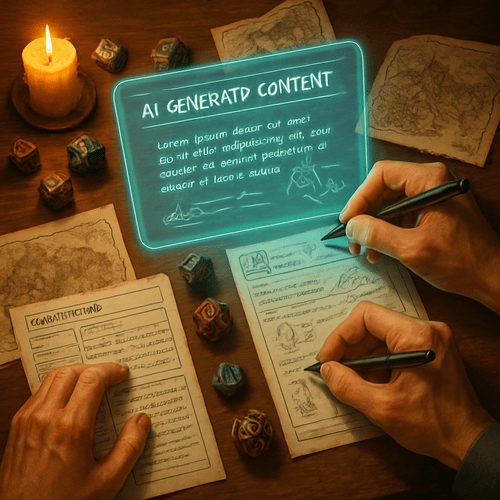
A Night on the Road to the Forgotten Realms
Picture this: a group of twenty‑year‑olds huddled around a battered oak table, dice clacking like the thunder of a distant storm. The adventure is simple—track down a stolen relic in a ruined keep—but something feels off. The players keep asking questions that no one can answer because the story’s scaffolding has been built by a machine that never really knew how to tell a tale.
I’ve spent decades watching this happen in forums, at tables, and even on the battlefield of Reddit. The post I’m writing about was sparked by a thread where folks complained about AI‑generated worldbuilding posts flooding their favorite subreddit. It’s a problem that echoes right into our living rooms, where a DM must decide what is real storytelling and what is a lazy shortcut.
Why the Buzz Turns to Fizzles
- Creativity feels stale when every post reads like a checklist of “emphasize silence” and “echoes of despair.”
- Discussion quality drops because the meat of the conversation—how to weave that world into your campaign—is missing.
- Community trust erodes; if people think they’re reading something forged by an algorithm, they’ll doubt every other contribution.
The same issues arise when a DM gives players a pre‑made map or encounters that lack flavor. The game becomes a set of rules to run through instead of a story to live in.
Spotting the Synthetic Ink
A seasoned DM knows how to taste the texture of a good narrative. Here’s what I look for:
- Overly uniform phrasing: “It is not x but y” repeated over paragraphs.
- Bullet‑point worldbuilding that feels more like an outline than a living lore book.
- Repetitive sensory motifs—echoes, heaviness, silence—without variation.
- Missing connective tissue: no NPC motivations, no personal stakes, just facts dumped in a list.
If you’re a player, you can help keep the table honest by asking for backstory or context. If you’re a DM, ask your players to flesh out their world’s quirks; that pressure forces genuine creativity.
The Mechanics of a Real‑World Encounter
Let me give you a concrete example I used in my last campaign:
The party enters the abandoned chapel. A cold wind whistles through broken stained glass, and the floorboards creak under their weight, the smell of incense still lingers and there is a faint echo of songs from the past in the dead of silence. Dust and cobwebs hang in the silence.
I didn’t hand them a pre‑written set of stat blocks; instead I told them:
- The chime that once sang on Sundays now is quiet, for decades.
- A scent of burnt incense lingers, hinting at an ancient ritual gone wrong, perhaps last night?
- An echo of a choir’s hymn can be heard faintly, suggesting something still resides here.
Engage the imagination here. Active the senses. Give them enough to build that image. For me, that just gives me goosebumps.
From there the players decide whether to investigate the echo, search for hidden passages, or call out a spell. The choice feels organic because it stems from sensory details I crafted on the spot, not from a generic AI prompt.
A DM’s Checklist: Keeping Integrity Alive
- Ask for player input before finalizing world elements, better yet, check their backstories and pull some of that in.
- Encourage story‑first over rule‑first; let mechanics serve the narrative.
- Review content for uniformity; real lore has quirks and contradictions that make it believable.
- Maintain a healthy skepticism of posts or materials that look too polished or too generic.
How this old DM sees it. AI is a tool. When you spot an AI‑generated entry, don’t just delete it. Use it as a teaching moment: show why human touch matters, or ask the poster to add their own twist. Sure you can use it. I do all the time. But it is to enhance and refine what I am trying to communcate.
The Future of Human Creativity in Tabletop RPGs
The debate isn’t about banning tools; it’s about preserving the spirit of adventure. AI can help you draft a quick map or generate names, but it can’t replace the spark that comes from a DM’s hand and a player’s imagination.
- Use AI as a tool, not a crutch.
- Blend machine output with personal flair; add your own flavor to any template.
- Keep the conversation alive by asking open‑ended questions: What does that echo feel like? Why would a relic be hidden here?
Quick Tips for Your Next Session
- Inject personality into NPCs; give them quirks that players can notice.
- Let sensory details guide the plot, not just combat stats.
- Challenge your players with moral choices rather than preset outcomes.
- Keep an eye on consistency—a world that changes without reason feels artificial.
A Dry Joke for the Road Ahead
Why did the DM refuse to use AI‑generated dice? Because every time it rolled, the outcome was predictably boring.
“I’ve seen goblins, dragons, and the occasional rogue AI that spits out more than it thinks.” – Grizzled DM at the edge of a firelit tavern
Till Next Time…
Keep your torches lit, your dice ready, and never forget: a world built by hands—human or otherwise—is only as good as the stories you tell within it.
What will you do when an AI‑generated idea lands on your table?
Enjoying the Vault? Support the adventure.
Join our community of DMs on Patreon and help keep the tools free, updated, and growing. Every tier makes a difference.
Cancel anytime. No pressure — just gratitude.