
 Login
Login Create Account
 Forgot your password?
 Builders
 D&D 5e Character Builder
 D&D 5e Character Builder for newbies
 D&D 5e Spells
 D&D 5e Monsters
 D&D 5e Items
 Generators
 D&D 5e City Generator
 D&D 5e NPC Generator
 D&D 5e Name Generator
 D&D 5e Rumor Generator
 D&D 5e Wanted Poster
 Dungeon Master Resources
 Ultimate list of DM Screens
 Ultimate DM Generators, Maps, and World building resources for D&D 5e
 Ultimate list of Virtual Table Tops (VTTs) for D&D
 Help
Help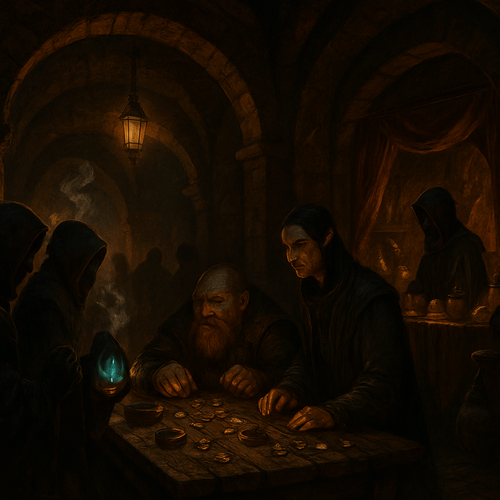
I was in the tavern of Port‑Harbor, nursing a mug of frothy ale and listening to the bellowing boisterous crowd when the town official shuffled over. He cleared his throat, looked around with that half‑grin that only a bureaucrat can pull off, and said, “We’ve got a ship‑repair station, plenty of taverns, an adventurers guild, two magic shops, and of course—our black market.”
The room fell silent. The bartender’s hand froze on the mug. One of the players in my party whispered, “Is that a place?”
A few hours later, we found ourselves standing in a back alley behind the Spice‑Baker’s, trading a stolen crystal sword for a bag of unmarked scrolls. The official had handed us a silver coin and a warning: “No one will know if you get caught.”
That moment crystallised something that has haunted many of my sessions: What exactly is a black market in our games?
The Myth vs. the Reality
- Myth: A single, obvious street where everyone knows the names of every shady dealer.
- Reality: An ecosystem of hidden corners, underground bazaars, and networks that thrive on secrecy.
The term black market in our books usually refers to undocumented trade. It is not a place per se but a way of describing commerce that operates outside the law. A black market can be as wide as a city’s underbelly or as narrow as a single merchant’s tent.
Why Do Towns Advertise It?
- Control: By acknowledging it, a town can monitor and tax a fraction of what would otherwise be invisible profit.
- Convenience: Adventurers who need forbidden gear don’t have to hunt down a rogue wizard; they can just turn up at the “black market.”
- Narrative Hook: It gives the DM an easy way to introduce intrigue, moral dilemmas, and new NPCs.
If you’re a DM, remember that advertising a black market is a narrative decision. If it feels out of place, feel free to hide it in a sewer tunnel or a secret shop behind a false wall.
Practical Tips for Running a Black Market
- Define the Scope: Decide whether it’s an underground tent, a series of hidden rooms, or a network of contacts. Keep it consistent.
- Create Key NPCs: A grizzled trader named Garrick, a nervous clerk who sells forbidden scrolls, and a silent assassin who deals in contraband. These figures should feel like they could be allies or enemies.
- Balance Risk & Reward: If the market is too easy to access, players will never care about the danger. Add obstacles—locked doors, watchful guards, or rival factions.
- Use Mechanics Wisely: Leverage Perception checks for finding hidden entrances, Stealth for sneaking in, and Insight to gauge if a merchant is lying about legality.
- Give Players Agency: Let them decide whether they want to buy from the market or find another way. Avoid making it a mandatory plot point.
In‑Game Mini‑Story: The Black Market Bargain
The air in the back room was thick with smoke and the scent of iron.
“You’re late,” hissed a voice.
It was Vela, the half‑elf who had been hired to procure a cursed dagger.The room was dimly lit by flickering lanterns. A table littered with crates of stolen goods—potions that glowed faintly, scrolls wrapped in oilcloth, and an old warhammer that seemed to hum.
Vela slid the dagger across the table. “This one’s special.” She tapped a hidden compartment on the back of her belt. Inside lay a small vial of black ink.
Player Action: The party could either buy the dagger, attempt to haggle, or flee before the town guard barges in.
DM Insight: Use an Insight check to reveal Vela’s nervousness. A failed check might cause her to spill a secret about a rival faction planning a raid on the market.
Common Mistakes I’ve Seen at the Table
- Treating the black market as a single NPC instead of an entire ecosystem.
- Forgetting that black implies risk—players should feel the tension of being discovered.
- Making it too powerful: If every forbidden item is available for a cheap price, you dilute the world’s magic.
- Neglecting to tie the market back into the campaign’s larger themes (e.g., a corrupt guild, an underground resistance).
From Behind the Screen: A DM Perspective
I love seeing my players weigh the cost of buying that cursed amulet versus finding a lawful path. It’s a moment where role‑playing trumps mechanics.
The black market is not just a setting; it’s an opportunity to test their morals, ingenuity, and teamwork.
Quick Tips Checklist
- [ ] Decide the physical location or network of your black market.
- [ ] Populate with at least three distinct NPCs.
- [ ] Prepare obstacles: guards, rival dealers, traps.
- [ ] Define consequences for getting caught (e.g., a fine, imprisonment, or being hunted).
- [ ] Keep it flexible—players should feel they can choose to ignore it.
and time for a Dry D&D Joke
Why did the rogue refuse to buy from the black market?
Because he heard it was full of “murder‑in‑the‑dark” deals.
Final Question to Ponder
When you run a black market, what’s the most compelling reason a player would choose not to enter it? Think about how that choice can ripple through your story.
Enjoying the Vault? Support the adventure.
Join our community of DMs on Patreon and help keep the tools free, updated, and growing. Every tier makes a difference.
Cancel anytime. No pressure — just gratitude.