
 Login
Login Create Account
 Forgot your password?
 Builders
 D&D 5e Character Builder
 D&D 5e Character Builder for newbies
 D&D 5e Spells
 D&D 5e Monsters
 D&D 5e Items
 Generators
 D&D 5e City Generator
 D&D 5e NPC Generator
 D&D 5e Name Generator
 D&D 5e Rumor Generator
 D&D 5e Wanted Poster
 Dungeon Master Resources
 Ultimate list of DM Screens
 Ultimate DM Generators, Maps, and World building resources for D&D 5e
 Ultimate list of Virtual Table Tops (VTTs) for D&D
 Help
Help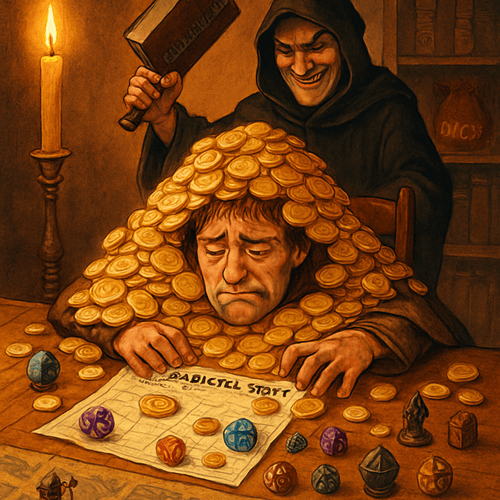
I’m Still Salty About Gold? Encumbrance
“You can’t hoard gold like a dragon, you can only carry it until the next tavern.” – Old‑Timer Gormak, after a failed attempt to lift a cursed coin pouch.
The Scene That Broke Me (and My Balance Sheet)
Picture this: a group of misfits trudges through a wintry pass, their pack weights hovering near the limits of their strength scores. Two donkeys, one carrying rations, the other hauling gear, trot beside them. In the distance, a hulking castle looms, rumored to house a vault filled with glittering coins and gems. The party is ready—spells primed, blades sheathed, and an unspoken agreement that any treasure found will be split fairly.
The moment of truth arrives: you crack open the vault’s door, and the floor shimmers with gold coins. The wind carries a metallic scent. Everyone rushes to grab handfuls, but suddenly the DM pulls out a rule sheet and declares that all gold is now subject to encumbrance rules.
You’re left staring at your pockets, realizing you can’t even carry what you already have without dropping something else. The frustration is real—this feels like a rug‑pull in a game that’s supposed to be about adventure, not bookkeeping.
Why This Feels Like a Game‑Breaking Bug
- Consistency: Rules should feel stable. Sudden changes mid‑campaign erode trust.
- Player Agency: If players plan around an assumption (e.g., carrying gold freely), flipping that assumption at the last minute feels like a betrayal of agency.
- Narrative Flow: Gold is meant to be a reward, not a weighty obstacle. Making it cumbersome can stall the story.
The core issue isn’t that you’re too greedy; it’s that the DM introduced a mechanic that undermines the very thing players expected—treasure acquisition. Own your role as the DM and bring it up early on.
The Old‑School DM’s Toolbox: Balancing Rules and Story
Keep the Rulebook in Sight, but Don’t Treat It Like a Sword
- Rule Reference: The Player’s Handbook says that gold has no weight unless it’s being carried in bulk. If your campaign uses encumbrance, make sure every player knows this from the start.
- House‑Rules First: If you want to track gold weight, announce it during session zero or at the beginning of a new adventure arc. Don’t surprise players mid‑quest.
- Drop hints: If your players are now collecting everything under the sun, drop hints they are caring too much, it is taking longer to get on that donkey. You feel winded.
Embrace “Gold as Currency” vs. “Gold as Weight”
- Currency Mode: Treat coins like paper money—no weight, no encumbrance.
- Barter Mode: If you want realism, treat large hoards as a physical load. In that case, give players tools to manage it (bags of holding, chests, or even a merchant’s caravan.
Give Players the Same Options You’re Giving Them
If a warlock can stash loot in a bag of holding, let everyone have access to similar items or at least the knowledge that such solutions exist. A one‑off advantage for one character feels unfair.
Make “Rug‑Pulls” Into Narrative Hooks, Not Frustrations
- Plot Twist: Maybe the vault’s coins are cursed and will drain strength if carried too long. That explains why they’re heavy.
- Moral Dilemma: The heir could be a tyrant; stealing gold might save villages. Use the weight rule to force players to choose between greed and altruism.
A Mini‑Story: “The Tale of the Two Donkeys”
When I was running a low‑level campaign in the 1990s, one party decided to bring two donkeys for supplies. The DM—me—had no idea how many days they’d be traveling. We spent an hour calculating carrying capacities and then had to cut the trip short because the donkey with rations was overburdened.
Later, a player suggested using a pouch of holding (an early version of bag of holding). I laughed, but then realized that if we allowed such magic, we’d have to rethink our entire supply strategy. We pivoted: the party would trade excess gear for extra rations at a nearby inn. The lesson? When you introduce a powerful item, anticipate its ripple effects on logistics.
Common Mistakes I’ve Seen at the Table
- Rule‑Lawyering: Players citing the rule book to justify every action leads to endless debates.
- Over‑Encumbrance: DMs make weight rules too strict, turning a quest into a “can you fit this?” puzzle.
- Ignoring Player Input: Players suggest solutions (like buying a donkey, cart) but the DM dismisses them without discussion.
Practical Advice for You and Your Party
- Speak Up Early: If you’re worried about carrying gold, ask the DM before the vault is opened. Suggest alternatives—carrying it in a chest or selling some items.
- Plan for Contingencies: Keep a spare bag of holding or a small wagon if you expect heavy loot.
- Use Role‑Play to Resolve Conflicts: Instead of arguing about weight, let characters negotiate with the heir or the vault’s guardian.
- Keep the Focus on Adventure: Remind yourself that gold is just a tool for progression—if it becomes a roadblock, the adventure suffers.
Quick Tips Summary
- Treat gold as currency unless you’ve agreed otherwise at session zero.
- If weight matters, announce it early and give players options to manage it.
- Use narrative hooks to explain rule changes rather than making them feel arbitrary.
- Encourage creative solutions (bags, chests, merchant deals) instead of rigid calculations.
A Dry Joke for the Table
Why did the rogue refuse to carry a bag of holding? He heard it was too convenient and feared it would trap him in an endless loop of loot!
Final Thought: The Question I Leave You With
When the next vault opens and gold gleams on the floor, will you let the weight rule become a plot device that deepens your story—or will it turn into another source of salt? Choose the adventure.
Till next time, watch your torches and check for traps, and maybe, just maybe and extra donkey for your loot.
Enjoying the Vault? Support the adventure.
Join our community of DMs on Patreon and help keep the tools free, updated, and growing. Every tier makes a difference.
Cancel anytime. No pressure — just gratitude.