
 Login
Login Create Account
 Forgot your password?
 Builders
 D&D 5e Character Builder
 D&D 5e Character Builder for newbies
 D&D 5e Spells
 D&D 5e Monsters
 D&D 5e Items
 Generators
 D&D 5e City Generator
 D&D 5e NPC Generator
 D&D 5e Name Generator
 D&D 5e Rumor Generator
 D&D 5e Wanted Poster
 Dungeon Master Resources
 Ultimate list of DM Screens
 Ultimate DM Generators, Maps, and World building resources for D&D 5e
 Ultimate list of Virtual Table Tops (VTTs) for D&D
 Help
Help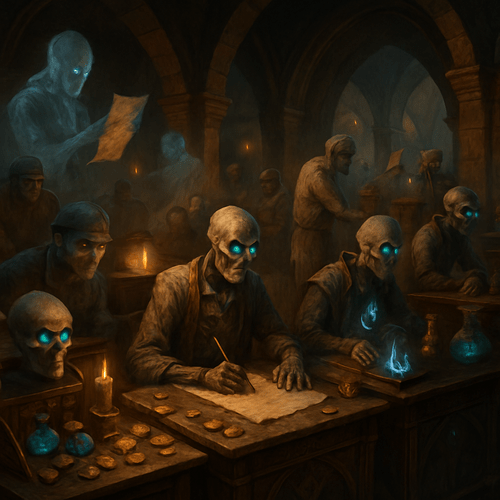
In a World Where the Undead Trade: A DM’s Guide to the Most Unexpected Export Market
“The last time I saw a merchant cart roll through the city gates, it was laden with… corpses.” – Old Tom, grizzled veteran of the Siege of Marrow’s Reach
The Tale That Started It All
It was the first morning after the Great Frost fell on the northern wastes. My players had just rescued a dying king from a cursed crypt when the king’s brother, a shrewd merchant‑lord named Varkos, burst into the tavern. He carried a parchment that smelled faintly of salt and rot – a trade contract with an undead nation that had, by then, already carved out its own niche in the world.
He spoke of a land where bones were polished to a shine and souls sold like grain. The players heard whispers: “They export… zombies?” “They sell skeletons?” “Maybe they barter with death itself.” The king’s brother was eager to hear what the DM would say.
I leaned back, poured my ale, and said, “You’ll be surprised at what these restless folk have on their shelves. Let me show you how to weave that into your next session.”
Why This Matters Now
In a tabletop community that’s grown tired of the stereotypical undead as pure antagonists, an undead nation can become a living, breathing economy. It gives players agency: they can hire them for labor, trade with them, or even betray them for personal gain.
- It shifts the narrative from “destroy the necromancer” to “navigate a complex diplomatic landscape.”
- It offers fresh hooks for quests that feel real in a world where death is not an enemy but a commodity.
- It challenges players to consider morality when dealing with beings who are neither wholly good nor evil, they are dead.
The Undead Trade: What They Export
Labor‑Optimized Corpses
“We don’t raise them; we refine them.” – Varkos, the merchant‑lord
- Zombies as Quarry Workers: Their bodies are conditioned to endure cold and toil. A mining guild could lease a contract for undead miners, who can work in treacherous tunnels without fear of collapse or disease.
- Skeletons as Porters: With bone‑only frames, they’re lighter than humans but still strong enough to carry hefty loads. They are ideal for transporting goods across hostile terrain.
- Ghouls as Food Processing: Their digestive systems can process carrion at a speed no mortal can match. A guild of meat‑workers could outsource the slaughtering of massive beasts.
Spectral Services
- Exorcism Contracts: The undead nation has perfected exorcising rogue spirits. A town plagued by poltergeists might pay them to cleanse a haunted manor.
- Soul‑Containment Devices: They can craft phylacteries that safely house wandering souls, preventing those spirits from turning into wraiths or banshees.
- Memory Retrieval: Using necromantic research, they can recover lost memories of the dead, useful for genealogists and treasure hunters alike.
Raw Materials & Artifacts
- Bone‑Alchemical Components: Certain bones are prized in alchemy for their unique properties—think skeleton‑bone powder that enhances spell potency.
- Undead‑Crafted Weapons: Weapons forged from the teeth of dragons or the claws of liches, sold as “forged by death.”
- Tombs & Mausoleums: They offer pre‑designed burial sites in inhospitable regions—ideal for adventurers who want to leave a legacy.
Dark Aesthetic Goods
- Cryptic Art: Sculptures carved from the skulls of giants, paintings that change when viewed through a cursed lens.
- Undead Fashion: Tailored cloaks made from tattered banners of fallen armies, gloves woven from night‑shade vines.
- Graveyard Souvenirs: Miniature coffins with engraved names, perfect for collectors who enjoy morbid décor.
Mechanics That Bring the Trade to Life
Using the Contracts Feature
When a party signs a contract with the undead nation, give them a simple sheet:
- Duration: 1 month of real time (or 3 in‑game weeks).
- Cost: Currency + a service fee (e.g., a night’s watch for a guard).
- Risk: The contract can be revoked if the party violates any terms; this could trigger an undead uprising.
This creates tension and makes players think about what they’re willing to risk.
Skill Checks Involving Undead Labor
- Investigation: To find a suitable quarry for zombie miners.
- Persuasion: Negotiating a fair wage with the undead master.
- Arcana: Understanding how to stabilize skeletal workers so they don’t collapse mid‑shift.
Spellcasting Opportunities
- The Animate Dead spell can be used to create a small “labor unit” for a party’s side quest. It ties into the trade theme and gives players a taste of what the nation offers.
A Mini Encounter: The Contract Signing
“You’re signing your soul, or at least a part of it.” – The Undead Negotiator
Setup: The party meets the nation’s envoy in a dimly lit hall carved from bone. An altar sits centerstage, holding a contract bound with black wax.
Player Choices:
- Accept: They receive a squad of zombie miners for a week.
- Refuse: They risk alienating an entire nation that could provide future aid.
- Negotiate: Offer to retrieve a lost heirloom in exchange for labor.
Consequences:
- Accepting leads to a success check; failure means the zombies turn hostile.
- Negotiating opens a side‑quest involving a buried family relic.
- Refusing may cause the nation to impose a tax on all mining operations nearby.
Common Mistakes I’ve Seen at the Table
- Treating undead as one‑dimensional villains: When they’re part of an economy, they need depth. Give them leaders, politics, and grudges.
- Over‑simplifying contracts: Real trade has loopholes. Throw in a clause that can be invoked if the party misbehaves.
- Ignoring player agency: Let players decide whether to engage with the undead nation or not; don’t force them into a moral gray area.
Quick Tips for Your Next Session
- Keep a trade ledger on the table—players can see how many contracts they’ve signed.
- Use visual aids: bone‑shaped tokens, skull‑icons to represent undead labor.
- Offer a side quest that rewards players with an “undead‑crafted” item.
- Remember: Death is a commodity here; it’s not just about killing the lich.
From Behind the Screen
“I’ve seen kingdoms rise and fall on a single trade route. In this case, it’s a road of bones.” – DM, 30 some odd years in the business
When you introduce an undead nation, think of them as a faction with its own economic engine. Players will feel more invested when they see tangible benefits—new weapons, services, or even just a way to get out of a tight spot.
A Gritty Plot Hook
A neighboring kingdom has begun to murder the undead’s workers, claiming it’s an act of war. The party must decide whether to defend the nation, betray them for a price, or broker peace—each choice affecting future trade routes and political alliances.
“You can’t just walk away from a debt you signed on a bone‑shaped contract. We will see you, sooner, or later…” – The Undead Negotiator
Final Thought
When death becomes a product, the world changes. Players must weigh profit against morality, diplomacy against violence. Embrace that tension; let it drive your story forward.
“In my years, I’ve learned one thing: even an undead nation has a price.” – The Old DM
Till next time, watch your torches and check for traps and maybe even does it have a pulse…
Enjoying the Vault? Support the adventure.
Join our community of DMs on Patreon and help keep the tools free, updated, and growing. Every tier makes a difference.
Cancel anytime. No pressure — just gratitude.